
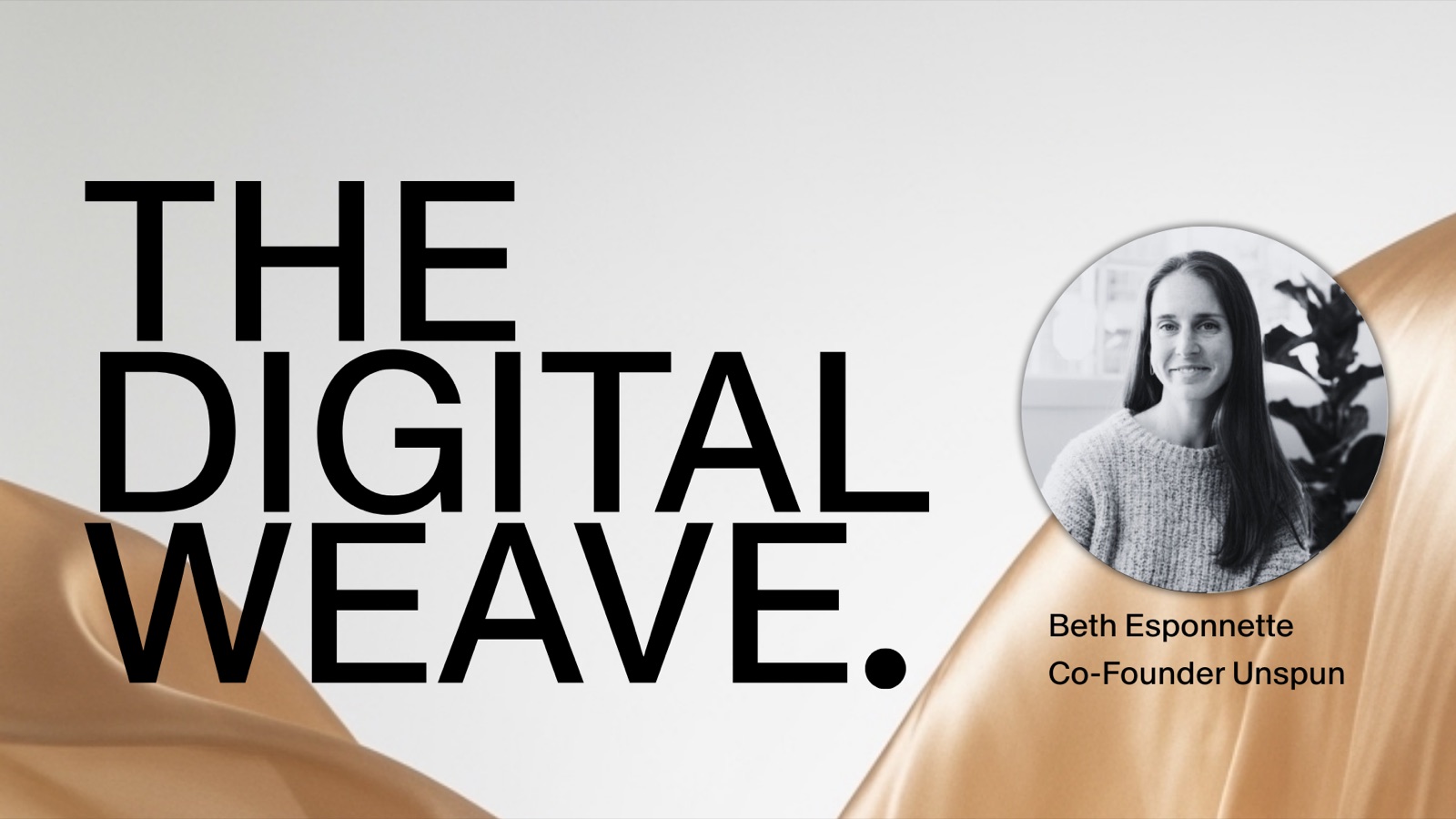
The Digital Weave is a space where we dive into real stories from brands and makers who are using tech to build labels and systems that are more sustainable, more profitable, and uniquely their own.
The Digital Weave is powered by The Fabricant, the leading AI fashion tool.
The Digital Weave - The Future of Manufacturing
Beth Esponnette is the Co-Founder of Unspun, the on-demand fashion technology company pioneering robotic 3D weaving—a process that builds garments directly from yarn without sewing. After studying apparel design and working inside the industry, Beth became frustrated with overproduction—an estimated 30 billion extra products made every year—and set out to reinvent how clothes are made. Since founding Unspun in 2015, she has been pushing fashion towards a truly on-demand model where products are sold first and made second, eliminating overstock and waste.
LinkedIn Beth Esponnette: https://www.linkedin.com/in/bethespo/
Website Unspun: https://www.unspun.io/
Instagram Unspun: https://www.instagram.com/unspun.io/
-----------
In this in-depth conversation, Adriana Pereira speaks with Beth Esponnette, Co-Founder of Unspun, about how robotic 3D weaving, on-demand production, and digital design are reshaping the future of fashion manufacturing—from the way clothes are made to how they reach the consumer.
First, Beth shares how Unspun is rethinking the fundamentals of garment manufacturing. By replacing the 200-year-old sewing machine with a robotic 3D weaving system, garments can be built yarn-by-yarn on demand, removing the need for cut-and-sew labour, large minimum order quantities, and long lead times.
Second, the discussion explores the role of on-demand production and overproduction. Beth explains how the industry currently produces around 30% more than it needs—roughly 30 billion extra products every year—and how making garments only after they have been sold can dramatically reduce waste, inventory risk, and the environmental footprint of fashion.
Finally, the conversation reflects on the journey of building deep tech in fashion. Beth talks about persistence, learning from other industries, and the role of curiosity in driving innovation, while Adriana draws parallels with her own seven-year journey building The Fabricant. Together they show how technology is quietly becoming the most powerful trojan horse for sustainability in fashion.
Together, this conversation offers valuable insight for fashion designers, brand founders, and manufacturers looking to understand how digital tools, robotics, and new business models can streamline production and reshape the future of fashion.
TRANSCRIPTION
00:00:00,260 --> 00:00:09,020 Adriana Pereira
[upbeat music] Hi, Bethany. Nice to have you here in the Digital Weave. How are you today?
00:00:09,020 --> 00:00:11,260 Beth Esponnette
Great. So good to see you.
00:00:11,260 --> 00:00:19,820 Adriana Pereira
Very nice to see you as well. Uh, I met, I remember, Unspun in 2019 at the Fashion For Good Accelerator-
00:00:19,820 --> 00:00:19,830 Beth Esponnette
[laughs]
00:00:19,830 --> 00:00:56,360 Adriana Pereira
... and we were the only tech companies trying to change fashion back then. And of course, fast-forward now, there are many more. But, uh, the story of Unspun, uh, has always resonated, uh, how innovative you guys have been in a field that, uh, that's quite tough, right? Production. And you came with this, uh, 3D weaving technology to, uh, produce the, back then, denim on-demand. Well, everything was just so fantastic. But we're gonna go there. Before we start, could you tell us a bit about yourself? How do you end up in fashion tech, right? What has been your journey?
00:00:57,600 --> 00:02:07,100 Beth Esponnette
Yeah, absolutely. And again, thanks for having me. It's so exciting to be here. I have just been fascinated by humans and what we create in the world, that kind of we're dreamers and then we dream something and we wanna make it. And I think something, like, we build these worlds around us, but we also just build the physical things around us, like we're creating these new worlds, and how intimate it is that you create, like, the products around you and physically here. And I think when I was younger, when I was probably 12, 13, I started to appreciate kind of like the art and the science of the clothing that we wear. And I don't know, I guess it started to set in that no one really appreciated it. Like, we- we would put these things on in the morning, but we weren't really thinking deeply about the, like, the science behind it and the, the fibers and the materials that were functioning on our bodies, and then the, kind of the art of it and, like, the expression that what you wear really says a lot about you. Even, even if you're like my husband and he puts on T-shirts and cargo shorts. Like, he's like, "Oh, yeah, I really don't care."
00:02:07,100 --> 00:02:07,110 Adriana Pereira
[laughs]
00:02:07,110 --> 00:02:23,220 Beth Esponnette
And it's like, but that actually says a lot about you. Like, there's, there's just so much there that I think is very overlooked in, in the everyday world, and I think I was fascinated by that, so I went to study clothing. I don't know that my parents were very happy about it.
00:02:23,220 --> 00:02:23,620 Adriana Pereira
Mm-hmm.
00:02:23,620 --> 00:02:38,810 Beth Esponnette
They've gotten over it since then [laughs]. I think they, they recognize, like, how, how much it, it matters to me and how curious I was about it. I think kind of curiosity is, like, the biggest driver, that I really wanted to know about this thing that I was putting on every day.
00:02:39,960 --> 00:02:52,400 Beth Esponnette
And so I went and studied clothing, essentially. It was called something else, but, you know, it was essentially clothing, looking at it from different angles. And it really, in, in my studies, it took... We took such a
00:02:53,540 --> 00:03:06,940 Beth Esponnette
positive spin to it. Like, everything was put in a good light. And so I think I was shocked when I got into the industry and was part of, part of the, you know, the gears, like-
00:03:06,940 --> 00:03:07,020 Adriana Pereira
Mm
00:03:07,020 --> 00:03:55,269 Beth Esponnette
... creating these problems, seeing the overproduction, um, seeing the waste, seeing the exploitation behind the scenes. And especially for companies that were on the cutting edge of, of functionality and treating their workers well, that they still ran into those problems. And I think, um, that then led me down a road of still being in the industry, but wanting to learn from other industries. How is manufacturing done elsewhere? How can we design differently? Um, and that led me to eventually, you know, thinking about how th- how we could do things differently at Unspun. But I guess to come back to your question, I've always just been driven by the, the positive sides, like, the self-expression, the creativity, um, that you get with, with the clothing that you wear.
00:03:55,269 --> 00:04:00,660 Adriana Pereira
Yeah. I can totally relate to that. I think we're, we're very similar in that sense. I spent, uh, 20 years in the industry-
00:04:00,660 --> 00:04:00,670 Beth Esponnette
[laughs]
00:04:00,670 --> 00:04:24,810 Adriana Pereira
... and, uh, always, like, loved, you know, what the industry can give to the world in terms of expression, innovation, right? Storytelling. Uh, but the more... I think the longer I stayed [laughs], the more frustrated I got, right? Uh, it was not changing. Uh, despite the fact that everybody that's in the industry, a few, has the intention to improve, right? I've never worked-
00:04:24,810 --> 00:04:25,060 Beth Esponnette
Oh, yeah
00:04:25,060 --> 00:04:38,680 Adriana Pereira
... with a company that people, like, didn't care. Everybody cares, but it just feels so hard to change when you're inside, right? So I had to also get out to try to change from the outside. Uh, and I'm most curious about, um,
00:04:39,800 --> 00:04:52,380 Adriana Pereira
how did you then go to Unspun? Was it, like, how did the idea come about? Uh, it's highly technological as well, right? You're talking about hardware and software. So how was that transition?
00:04:53,700 --> 00:05:00,370 Beth Esponnette
Yeah. Yeah, that's a great question, and it was not a direct path, and I think it was
00:05:01,800 --> 00:05:06,440 Beth Esponnette
a lot of experimentation. But going back to seeing the f- the
00:05:07,600 --> 00:06:11,892 Beth Esponnette
frustration, or, like, the frustration that I was having with the industry and not wanting to show up at work anymore and, and be another cog in the, in the machine. 'Cause part of my job was to ad- you know, various roles as, like, entry level, but one was to, to take a bomb on a product and figure out how to take away cents from each of the pieces and reduce labor costs and just, like, really chip away at the, the bottom in the manufacturing. And it's like they have such small s- margins, it really started to eat away at me. So I had this moment where I was like, "I don't feel like I have anything to lose here, and I'm really curious about other ways of manufacturing and other ways of doing things. Let me take time away to go explore those." And I learned through the process that a lot of the problems that we're dealing with, at least for-In terms of overproduction, making, you know, 30% more than what we actually need in the industry, which amounts to about 30 billion extra products every year that we really don't need.
00:06:11,892 --> 00:06:12,192 Adriana Pereira
Wow.
00:06:12,192 --> 00:06:20,012 Beth Esponnette
For me, that was like, oh, maybe, maybe it's the way that we make it. We, we make the product
00:06:21,292 --> 00:06:38,192 Beth Esponnette
and then we try to sell it, and we don't know that it should exist in the world, and why do we do it that way? And digging into the supply chain, it kind of felt like, oh, it's because we still use a sewing machine, which requires a lot of manual labor, sitting, sitting there, and that
00:06:39,672 --> 00:07:53,272 Beth Esponnette
because you're using, like, more expensive manual labor, um, you're going to then think about how you cut costs, and one way is to just make a lot of the same thing. So now you have these really big MOQs, and now you have these long lead times because you have big MOQs and because you have all this labor. And it just kind of, like, stacks up to this thing where suddenly you have to, 18 to 12 months ahead of time, guess what you're going to want in these really big quantities. And, um, for me, it was like, why, why do we do it this way? Um, I really do admire the sewing machine. I love sewing, like, I was just sewing a project last week. But, uh, it hasn't been chang- like, it's, it was invented over 200 years ago, and there's so much cool technology, as you know, you know, building Fabricant, like, there's so much cool technology that's been developed since then, since the 1830s. And so yeah, it was kind of that question on, okay, using the technology that's out there now, how might we set up the industry? How could we make products on demand, where you actually, uh, sell them, and then you make them, knowing that there is a home for them, so you wouldn't have that overproduction? So that led to
00:07:54,552 --> 00:08:06,822 Beth Esponnette
actually trying to answer that question, how can we make on demand, which is a really super vague, like, i- in a way, that's great. It's great that it's vague, 'cause then you start to pull in weird ideas. I was
00:08:08,272 --> 00:08:14,872 Beth Esponnette
doing, doing some weird things, like growing, uh, chia, like, plants on mannequins in my garden to s-
00:08:14,872 --> 00:08:14,902 Adriana Pereira
Oh, my God. [laughs]
00:08:14,902 --> 00:08:17,261 Beth Esponnette
You know, if you like, like growth. Uh-
00:08:17,261 --> 00:08:17,261 Adriana Pereira
So good
00:08:17,261 --> 00:08:25,632 Beth Esponnette
... using hot glue to kind of, like, additively build products. And it was all just kind of part of the process of exploring kind of what ifs.
00:08:26,732 --> 00:09:20,332 Beth Esponnette
What if we could additively build something? And, and trying, trying lots of different materials, real- realizing they're not realistic for the commercial world, but then landing eventually with yarn, and saying, "We all wear yarn. We [laughs] we're all very happy with our yarn that we wear. It just happens to, uh, have been made into a fabric, and then cut and sewn together. Maybe we can think about skipping the fabric stage, taking yarn, and then creating a final product from it," which is not new. Like, that's how knitting has been forever. If you see someone knitting a s- a sweater, like, they are, they're doing it straight from yarn, right? They're going to the final garment. So we're, so we're essentially trying to do the same thing, but with weaving. Um, and so it's not new in the sense of, like, the c- overall concept, but specifically using weaving and creating, uh, 3D with weaving is, is new.
00:09:20,332 --> 00:09:34,192 Adriana Pereira
It's, it, it's, it's fascinating. I think that [laughs] I mean, the whole exploration is fascinating. I have thousands of questions. So one of the questions [laughs] is, yeah, I love this. It's, uh, it's pure play design thinking, back to, yeah, back to play with fashion, right? Which, uh, almost, like,
00:09:35,212 --> 00:09:39,032 Adriana Pereira
brings back to your memories of your childhood of, uh, right?
00:09:39,032 --> 00:09:39,282 Beth Esponnette
Yes.
00:09:39,282 --> 00:09:56,312 Adriana Pereira
But I'm, I'm curious about, uh, did you do it as a, as a, your own project? Did you involve other people? How long did the exploration take? You know, what led you to ultimately 3D weaving as the solution? How many pathways did you go through before you get there?
00:09:57,512 --> 00:10:49,542 Beth Esponnette
Yeah, that's a great question. I'm trying to go back memory lane here. So I was in my second year of my master's program, which gave me a lot of freedoms to just try new things, and I think that was something I, I was lucky to have. Not everyone has that time. It was really... But you could, you can carve out time in, in your evenings to do some silly things. So in my second year of my master's, there was an opportunity to pretend to start a, a company, and I kind of, I knew I wanted to do something like this and explore it, and it gave me the excuse to, I don't know, have a, have kind of a test run at it, 'cause I had never led a team like that before. And so other students joined my project, and I got to practice, you know, inspiring them to, to work with me, and it was really fun. No one from that class kept going with me. [laughs]
00:10:49,542 --> 00:10:49,552 Adriana Pereira
That's okay.
00:10:49,552 --> 00:11:01,912 Beth Esponnette
But they went to, you know, Twitter and Facebook and some other lucrative careers, but, but it, but I think we all had a good time working together. And it took about a year of the experiments, and there were probably
00:11:03,192 --> 00:12:14,164 Beth Esponnette
five solid ones, 10 kind of, uh, murky ones in total, and, um, they eventually led to the, the 3D weaving. And the, there were a few 3D weaving machines. Machines, not even the right, prototype is the right word, kind of monster prototypes that we ended up with from that class, and they were all really embarrassing, but they were enough to get that next... Like, you know, starting a company, you've gotta take baby steps. You gotta slowly put the pieces together, inspire the next person, inspire the next person. So those early prototypes were just enough to get us to inspire a class at the University of Colorado, um, in Boulder, to then doing a next prototype for us. And then from there, that was enough to inspire the National Science Foundation to give us some money for another prototype. And from there, we h- got enough money to work with HAX, an accelerator in Shenzhen, on our next prototype. And so you just slowly get-Uh, less and less embarrassing, but [laughs] still, uh, I, I'm, I'm not, no longer embarrassed by the machines, but the first few were... Uh, we have them on a shelf at our, at our office. They're very, they're very humbling.
00:12:15,404 --> 00:12:21,584 Adriana Pereira
That's amazing. And how long did, did it take, the whole process from your first prototype to actually your commercial, uh, launch?
00:12:21,584 --> 00:12:52,604 Beth Esponnette
Ooh. Well, up until last year, so about ei- almost eight years. [laughs] Yes. Took a long time. Hardware, I mean, and technology in general is extremely hard, but hardware is like sometimes things just physically hit each other, and you've gotta figure out how to make the system work every time and be reliable. Um, and so yeah, just, uh, until last year, which is, or like in 2025 is when we deployed our first machine. So, uh, yeah, from 2017 to 2025.
00:12:53,304 --> 00:12:56,914 Adriana Pereira
Wow, that's... What a journey, and what a journey of resilience. Uh-
00:12:56,914 --> 00:12:56,914 Beth Esponnette
Yes
00:12:56,914 --> 00:13:23,844 Adriana Pereira
... well done. Well done. Uh, this is like a whole topic in itself. But let's now go... Now y- you, you actually have what you have been working really hard for, and I know you have some really, uh, big clients, uh, using your technology as well. So can you explain a bit, if I'm a brand and want to work with Unspun, and I want to create 3D weaving, um, which means ultimately the closest to on-demand production, as you said, right? So you're gonna produce-
00:13:23,844 --> 00:13:24,024 Beth Esponnette
Yeah
00:13:24,024 --> 00:13:30,084 Adriana Pereira
... what, uh, what you actually need, uh, no waste, real time. Can you explain me a bit of, um,
00:13:31,244 --> 00:13:40,624 Adriana Pereira
what does it take for me to, to join you? You know, what kind of brands do you have? And also the, the process in itself, like, uh, how does it work?
00:13:42,084 --> 00:15:52,164 Beth Esponnette
Yeah, great questions. So our two biggest partners are, are Walmart and Decathlon Sports. We've got other smaller brands, but I think those ones illustrate kind of the scale that we're working towards. And with those partners and, and the ones that have existing products that we're basically trying to shift into our 3D weaving process, we start typically kind of... We try to fit in with their standard process, which would be to first try to develop the material, so working with them to get their spec sheet of what the fabric would be, and then we try to emulate as close as we can to that final material, um, on our machine. So then we'll send them the material to get approved, go through all the testing. So then once that step is done, then we move to the, to their tech pack. So they have a tech pack that they'll share for the product that we wanna create. So we'll do... We'll start with the same process that they're used to, which is usually to start with a sample size, and so we'll create that sample size, understanding the, the silhouette and style, you know, the construction, the fit, um, and make sure that that works well on its own. As soon as the, that sample size is approved, we then move to the size set. And so for the size set, we're gonna need pro- the patterns. Well, of course you need the pattern also for the sample size, but you need the nested patterns for the, the size set. So collecting all this information from a brand is really useful for us to l- nail what they're already, what they've already created, what they're confident in. But we don't have to do it that way. We could also say, "We've got this new process. Uh, you're welcome to use our design tools to create your own pant." We're pretty focused on pants right now. And they can then use that software to create it and kind of build it from scratch. But I think given the scale we're aiming for here and the scale of those particular brands, they usually start with, like, a tried and true, like, chino or workwear pair or, or denim jean that they're, that they're happy with.
00:15:53,224 --> 00:16:00,104 Adriana Pereira
And what is, uh, f- first thing, white pants, which just to me kind of it's more complex than a, a shirt or T-shirt.
00:16:00,104 --> 00:16:01,304 Beth Esponnette
Yes. Yes.
00:16:01,304 --> 00:16:01,644 Adriana Pereira
White-
00:16:01,644 --> 00:16:02,084 Beth Esponnette
Oh, yeah
00:16:02,084 --> 00:16:02,644 Adriana Pereira
... pants. Yeah.
00:16:03,874 --> 00:16:03,884 Adriana Pereira
[laughs]
00:16:03,884 --> 00:16:18,654 Beth Esponnette
Pants are, are really challenging for fit. I... There's so... There were so many pain points in, in pants when we were s- first doing research on, like, the on-demand model. Where would, where would customers find the most benefit from-
00:16:18,654 --> 00:16:18,764 Adriana Pereira
Mm
00:16:18,764 --> 00:16:39,854 Beth Esponnette
... an on-demand model that would allow them to customize the fit? And lots of people complained about the denim not fitting and jeans not fitting as, as nicely as they'd want, so it felt like the right direction to go after. Plus, it's a great, like, a weave, which is exactly what our technology addresses.
00:16:39,854 --> 00:16:39,884 Adriana Pereira
Mm.
00:16:39,884 --> 00:16:58,314 Beth Esponnette
We don't do anything related to knitwear. And, um, it's about the same weight that we're able to achieve right now. We're between, like, 250 and 400 GSM, and most, most bottoms are gonna be ar- around that weight. So it, like, a perfect... Well, I guess you could also say that the market is very big. [laughs]
00:16:58,314 --> 00:16:58,384 Adriana Pereira
Mm-hmm.
00:16:58,384 --> 00:17:01,304 Beth Esponnette
So that's another reason to kind of chase it. Yeah.
00:17:01,304 --> 00:17:14,804 Adriana Pereira
And y- and you know, like, you have two very big clients, right? Decathlon and Walmart. Uh, is it... Would you say that the profile of clients right now need to be large volumes, or would you say small brands could also have a, have a go?
00:17:16,144 --> 00:17:17,944 Beth Esponnette
Yes. I love this question because,
00:17:19,004 --> 00:17:52,464 Beth Esponnette
you know, longer term, I want us to be agnostic to who we work with and just be a platform. Similar to the Fabricant, like, you, you are a platform for, for people to take it and run away with it, right? We wanna do that but, like, in the physical world of manufacturing. And so we, we want to continue to work across the, the spectrum of brands. Our first launches were a little bit higher end, like Ecosalata and New York Fashion Week, Anne Caoche with TAG at, in Paris. Um, those ones we wanted to show,
00:17:53,544 --> 00:18:34,126 Beth Esponnette
show some of the creativity, like they used really interesting materials. They did some interesting things with the weave patterns, and that was a lot of fun. And we have a few other collaborations we're launching early next year that will show more of the, the luxury side that you can get with this if you, you know, you're using the right materials. Sim- similar to what you would seeLike a sewing machine is able to make for Walmart, and it's also able to make for, you know, uh, Louis Vuitton. Like, it doesn't matter that it was a sewing machine, it got you the thing at the end of the day. But there are things that you can tweak, like how fast or slowly you do it, what are the construction methods, and what are the materials that you put in.
00:18:34,126 --> 00:18:34,156 Adriana Pereira
Mm.
00:18:34,156 --> 00:18:40,206 Beth Esponnette
Similar- that's similar for us too, so we want to be able to kind of meet, meet both.
00:18:40,206 --> 00:18:43,636 Adriana Pereira
Mm. Interesting. And if I'm a, a brand right now, um,
00:18:45,136 --> 00:18:51,596 Adriana Pereira
when would you be... Would you say, "Okay, now is the moment to talk to us"? What's, uh, yeah, what's the ideal condition to-
00:18:51,596 --> 00:18:51,836 Beth Esponnette
Yeah
00:18:51,836 --> 00:18:53,036 Adriana Pereira
... work with Unspun at this moment?
00:18:53,036 --> 00:18:56,146 Beth Esponnette
[laughs] I feel like I've seeded this question. Thank you. [laughs]
00:18:56,146 --> 00:18:57,326 Adriana Pereira
[laughs] Yeah, I- I-
00:18:57,326 --> 00:18:57,666 Beth Esponnette
Uh, right now-
00:18:57,666 --> 00:18:59,096 Adriana Pereira
... that that lets you into the future vision-
00:18:59,096 --> 00:18:59,106 Beth Esponnette
Yeah
00:18:59,106 --> 00:19:04,656 Adriana Pereira
... and I love it, but, uh, I equally, uh, yeah, would like to say, okay, right now where we are, so that-
00:19:04,656 --> 00:19:05,026 Beth Esponnette
Right now. Right now. Right now
00:19:05,026 --> 00:19:06,126 Adriana Pereira
... uh, people that listen can say-
00:19:06,126 --> 00:19:06,126 Beth Esponnette
Yep
00:19:06,126 --> 00:19:14,096 Adriana Pereira
... "Okay, I, I want to talk to Beth, and I think I, I fit the profile of, uh, of the client that you are able to serve right now."
00:19:14,096 --> 00:19:32,396 Beth Esponnette
Yeah. Yeah. I really appreciate that platform. So with our current partners, we are working out what that deployment schedule looks like. Like, we w- we have machines that we're getting ready to deploy to meet their needs and meet the capacity that they've asked for, and then we're looking at additional partners. Um,
00:19:33,916 --> 00:20:00,956 Beth Esponnette
so it's basically middle of 2026 is when those deployments happen, so it'd be between 5 and 15, probably closer to 10, uh, machines that will be going out in the middle of next year. And to be part of that, we would need to start talking basically, uh, now and, [laughs] and be, be done talking, um, and have something agreed on within the month of February, basically.
00:20:00,956 --> 00:20:02,276 Adriana Pereira
Okay. Okay, well, that's amazing.
00:20:02,276 --> 00:20:10,216 Beth Esponnette
But we're, we're always talking to new brands. We love hearing, you know, what their needs are. Do they wanna do on-demand? Do they want to just
00:20:11,456 --> 00:20:21,426 Beth Esponnette
have the ability to, to replenish faster? Do they wanna have local production? Do they just want to think about, you know, smaller MOQs, um-
00:20:21,426 --> 00:20:21,426 Adriana Pereira
Mm
00:20:21,426 --> 00:20:28,756 Beth Esponnette
... in their current supply chain? So th- there are a lot of different reasons to, to go after this, and we're always curious kind of what those main reasons are.
00:20:28,756 --> 00:20:38,216 Adriana Pereira
Yeah, no, I love, I love to talk about the reasons actually. Before I go there, is there a geographical limitation? Like I... Is it only US-based, or does, does it really matter?
00:20:39,876 --> 00:20:44,956 Beth Esponnette
Great question. Right now we are focused on Europe and the US. We do have
00:20:45,996 --> 00:21:06,396 Beth Esponnette
a lot of interest. We're, we're employing whether, um, Southeast Asia makes sense or not because it's where the supply chain is. It would be very easy to integrate, um, because it's all, the ecosystem is already there. It's just a question of whether we're ready to disrupt kind of what's there.
00:21:06,396 --> 00:21:06,716 Adriana Pereira
Mm.
00:21:06,716 --> 00:21:11,856 Beth Esponnette
What we've been really targeting is to bring manufacturing back to where it's left.
00:21:11,856 --> 00:21:12,116 Adriana Pereira
Mm-hmm.
00:21:12,116 --> 00:21:37,596 Beth Esponnette
I think that's kind of our, our main goal. And so that's why I think we have some tension in our heads on there's a lot of, there are a lot of, um, manufacturers who are asking over there, and we're, we're just a little scared of, um, reducing the number of jobs that already exist there. And if you work with Europe or the US, you're actually net increasing jobs since so much of the supply chain has, has left.
00:21:37,596 --> 00:21:50,126 Adriana Pereira
Mm-hmm. Interesting. Yeah. I, I feel that there is, a lot of people I'm talking to, there is that indeed back to close by manufacturing, right? Micro-manufacturing in Europe and US, whether it's because of, uh, trade wars or-
00:21:50,126 --> 00:21:50,126 Beth Esponnette
Yes
00:21:50,126 --> 00:21:52,616 Adriana Pereira
... [laughs] let's not go there, but, uh-
00:21:52,616 --> 00:21:52,766 Beth Esponnette
Yeah. Yeah
00:21:52,766 --> 00:22:11,556 Adriana Pereira
... but certainly cle- clear that, uh, US and, uh, and Europe are now your focus points, and, uh, I think important for the public also to know. I would love to dive a bit into the benefits. So as you're saying, if y- if I'm a brand and I work on with, with you, what are the clear benefits for me?
00:22:12,816 --> 00:22:13,216 Beth Esponnette
Yes.
00:22:14,336 --> 00:22:19,556 Beth Esponnette
We honestly have... I think this probably happens with a lot of startups.
00:22:20,616 --> 00:22:38,535 Beth Esponnette
There are a lot, and it's, it's like where do we highlight, um, and what? So most immediately there are efficiencies gained, so you can look at the efficiencies on a unit level, like garment to garment on the manufacturing, and then you can also back up and look at it from, like, a systematic level.
00:22:38,536 --> 00:22:38,636 Adriana Pereira
Mm-hmm.
00:22:38,636 --> 00:23:03,536 Beth Esponnette
So on a unit comparison level, we can basically take a SAM, like a standard allowable minutes kind of breakdown that you would have when you're looking at a production, um, p- like for a garment, and say, "This is how long it takes to finish this garment with this method, the traditional method, and here's what it takes with Unspun's method," and it's about 50% faster-
00:23:03,536 --> 00:23:03,975 Adriana Pereira
Oh, wow. 50%
00:23:03,975 --> 00:23:45,285 Beth Esponnette
... with Unspun's m- method. Yeah, because of the reduction in the manual steps that, that you would do to... 'Cause we're basically cutting out the fabric stage, um, and weaving to shapes. You're re- you're taking out, um, the sewing steps, and so that really reduces that part. Um, and then the part that we're... that actually drove us in the first place to create this is, is looking at overproduction. So in our current model for some of our bigger customers, we're not doing on-demand, we're doing a replenishment model where, you know, their stock goes low in a store and we're able to replenish it locally, like nearby-
00:23:45,285 --> 00:23:45,446 Adriana Pereira
Mm-hmm
00:23:45,446 --> 00:24:09,496 Beth Esponnette
... um, and get it to them faster. So the, the case for reducing inventory is still there, but it's not quite as clear as it would be for someone bought the product, now you make it, and now you have zero excess inventory because it's a, a one-to-one. We'd like to get there eventually. And so, and there are s- a lot of brands that, that see that in their future.
00:24:09,496 --> 00:24:09,756 Adriana Pereira
Mm-hmm.
00:24:09,756 --> 00:24:44,330 Beth Esponnette
But they know it's gonna be, like, a year or two before their, their customers are, are really ready for that kind of model 'cause-A lot of customers want the thing to exist before they buy it, and so it's kind of a funny thing. But since so much has gone online, that actually, and because of technologies like the Fabricant that can help build trust with, with people. Like, "Look, this is what this thing would look like, and look how realistic it is." And maybe it even tricks them to thinking it is, it does already exist. Those are the kinds of things that will, will drive it forward. So those are, like, the most immediate-
00:24:44,330 --> 00:24:44,330 Adriana Pereira
Mm
00:24:44,330 --> 00:25:41,700 Beth Esponnette
... um, benefits are, like, the efficiencies. But then for product nerds like me, there are the benefits on the product side of thinking about a product more holistically and thinking about being able to not only, like, custom fit a product, but be able to weave it in a way that's more, um, suited to a function. So for example, if you were to weave a shoe, you could actually weave different zonal structures and different pieces so that you have different properties throughout the shoe. Um, where normally you'd have to take a bunch of pieces of fabric and stitch them together or somehow, like, glue them or adhere them together to get those different properties. But now with this you can, because of our Jacquard capabilities in our machine, actually s- like weave those in. It's all one, one piece. So that's where the product nerd in me kind of, like, goes in the l- the longer term. But right now we're a little more focused with our customers on the, the efficiencies aspect.
00:25:41,700 --> 00:25:47,980 Adriana Pereira
Yeah, but even in the replenishment, I guess you have gains on, uh, inventory reduction, right? Because-
00:25:47,980 --> 00:25:48,460 Beth Esponnette
Yes, yeah
00:25:48,460 --> 00:25:57,200 Adriana Pereira
... you don't need to pre-produce so, so much, so there will be, uh, uh, waste reduction, uh, cost savings, uh, efficiencies, right, uh-
00:25:57,200 --> 00:25:57,340 Beth Esponnette
Yes
00:25:57,340 --> 00:25:59,660 Adriana Pereira
... throughout, throughout the chain. Absolutely.
00:25:59,660 --> 00:26:00,590 Beth Esponnette
Absolutely. Yeah.
00:26:00,590 --> 00:26:14,980 Adriana Pereira
Amazing. And in the, in the, in the moment that you would do a, a true on-demand model, uh, how much time do you think it would be from me as a customer placing an order to actually having it delivered at my door in the current-
00:26:14,980 --> 00:26:15,170 Beth Esponnette
Yeah
00:26:15,170 --> 00:26:15,660 Adriana Pereira
... state of things?
00:26:15,660 --> 00:26:38,680 Beth Esponnette
Yeah. We've, we've gone through this, the manual method, and then we've done some really small case studies internally on our, our new method. And back when we were working on our custom fit jeans line, where we... It was all software, and then you got a body scan and were able to get your custom fit jeans. That was a three-week turnaround.
00:26:38,680 --> 00:26:39,460 Adriana Pereira
Mm-hmm.
00:26:39,460 --> 00:26:45,980 Beth Esponnette
And that was a long time, because you had to lay out one layer... 'Cause it was made with a cotton, so-
00:26:45,980 --> 00:26:46,120 Adriana Pereira
Yeah
00:26:46,120 --> 00:27:14,949 Beth Esponnette
... traditional method. One layer of fabric, cut it out, stitch it together. It's, it's every product is unique, and you still have to sit at a sewing machine for that, and it was a $200 product. And so looking at our method here, because you're using digital tools to drive the machine, whether you're doing all the same product or everything is completely unique, it's going to run through the machine in the same way, uh, either way.
00:27:14,949 --> 00:27:14,980 Adriana Pereira
Yes.
00:27:14,980 --> 00:27:16,729 Beth Esponnette
Similar to, like, 3D printing, where-
00:27:16,729 --> 00:27:17,280 Adriana Pereira
Yeah
00:27:17,280 --> 00:27:46,060 Beth Esponnette
... it doesn't matter, it's just weave jobs going to the machine. So that really reduces the cost, and it reduces the speed, 'cause you're not, like, laying out a layer of fabric and, and cutting it. So for that, more realistically as we launch, a week turnaround is where we'll be. But not even a year in, we anticipate being able to, like, depending on how we set up the fleets of factories, um, getting that down to under two days would be the goal for, like-
00:27:46,060 --> 00:27:46,280 Adriana Pereira
Wow
00:27:46,280 --> 00:27:47,780 Beth Esponnette
... local areas. Yeah, yeah.
00:27:47,780 --> 00:27:48,130 Adriana Pereira
Wow.
00:27:48,130 --> 00:27:48,160 Beth Esponnette
Yeah.
00:27:48,160 --> 00:27:50,020 Adriana Pereira
That is amazing.
00:27:50,020 --> 00:27:50,160 Beth Esponnette
Yeah.
00:27:50,160 --> 00:27:51,020 Adriana Pereira
Two days-
00:27:51,020 --> 00:27:51,030 Beth Esponnette
Yeah
00:27:51,030 --> 00:27:53,720 Adriana Pereira
... is, uh, I'm down for it. That's, that's-
00:27:53,720 --> 00:27:54,180 Beth Esponnette
Yes
00:27:54,180 --> 00:27:54,400 Adriana Pereira
... really good.
00:27:54,400 --> 00:27:54,580 Beth Esponnette
Yeah.
00:27:55,630 --> 00:27:55,830 Adriana Pereira
Really good.
00:27:55,830 --> 00:27:57,680 Beth Esponnette
And I think that's where, like,
00:27:58,920 --> 00:28:00,620 Beth Esponnette
putting tools together with,
00:28:01,640 --> 00:28:22,840 Beth Esponnette
um, like, what exists in AI and, and rendering and being able to show a customer what they're getting so that, you know, they can order it and get it in the two days versus having to make it. Then maybe they don't want it, and now you have this, this thing. Like, you always had all this excess inventory. So yeah, excited for that.
00:28:22,840 --> 00:28:34,119 Adriana Pereira
You guys have been, uh, in many ways visionaries, right? Uh, uh, motivated by very strong vision. So I, I love, uh, asking the question, how do you see the future of fashion?
00:28:34,120 --> 00:28:36,940 Beth Esponnette
Ooh. Oh, man. They're... It's
00:28:37,979 --> 00:29:55,320 Beth Esponnette
one of those things where I've been in the industry long enough and have seen... Like, I can go back to what I was thinking I was seeing five years ago, and it just hasn't... Like, in some ways it's absolu- absolutely gone there. In other ways it hasn't. Like, five years ago, sustainability and, like, a direction and executives and people wanting to make sure sustainability is something they're chasing would've been on the top of my list, and now it's just not there. Like, they're... People are not asking for it. So, so earlier I mentioned, like, the, the value propositions is really, like, efficiency and, like, product, uh, capabilities, right? But what was the thing that drove our company in the first place was overproduction and this, this goal to, um, try to achieve a more sustainable way of manufacturing. The fact that I didn't even mention that is, is a little bit scary. Hopefully it will, it will come back. But I think there are a lot of macro trends that are pushing the industry right now and challenging it. You know, you mentioned tariffs earlier. That's gonna be, and already is, a big one that's shifting the global landscape. We, we have so many partners who
00:29:56,500 --> 00:30:40,108 Beth Esponnette
they're talking to us because they, they see it as a way to localize, because now you're not paying the, the labor costs that you would normally pay on shore, because you've automated that production. So that's something that's really big, and we're excited. Even though tariffs are messy, I don't like the way that it's been done, it's, I think, overall good to, to shake it up a little bit and get people thinking about w- how we could set up, um, those supply chains differently. Um-Economic uncertainty is another thing that's driving people maybe not in the right direction, but it's still shaping where we're going. I think there's a lot in transparency, which is good.
00:30:41,328 --> 00:30:49,808 Beth Esponnette
Like, what, 10 years ago Ron Applauza was a huge deal. Then just last year seeing, uh, Pantomandu, um,
00:30:50,928 --> 00:31:24,188 Beth Esponnette
at least within the industry and most of my friends had heard about it, I think 20 years ago that wouldn't have really made the news as much as it did. So I think there's a little bit of progress in terms of transparency, and hopefully that's gonna be driving brands to think a little bit better. I think some of these issues that, like, Loro Piana and other brands have had and with the quote-unquote "sweatshops" that they're seeing in Italy, I'm hoping that they start to [laughs] be a little bit smarter with their supply chains, and then maybe that will kind of trickle down. But these things j- take so long.
00:31:24,188 --> 00:31:24,248 Adriana Pereira
Yeah.
00:31:24,248 --> 00:31:35,528 Beth Esponnette
Um, and so that's kind of, like, the, the macro side. But on ... in terms of, like, actually being able to make a difference, 'cause I don't know if you feel this way, but
00:31:36,568 --> 00:32:17,758 Beth Esponnette
sometimes thinking about the industry and removing myself from my current position, I feel helpless. And then I put myself back in my shoes at Unspun, and I'm like, "Look how much we've done in the last eight years. Like, this can really happen." And then that gives me hope, and I can imagine it's the same with Fabricant. Like, you, you're far away and it's like, "Ah, there's nothing we can do," and then you get behind the wheel and realize, like, there's so much that you really can control if you, if you dive in. So I think that leads me down this path of, like, how excited I am for robotics, automation, and AI, like, all of that technology, and how much it's really shaping up the industry right now. Um,
00:32:19,268 --> 00:32:27,628 Beth Esponnette
I think that's gonna be a force that you're not gonna have executives kind of like, "Oh, should we do sustainability?" Like, "Oh, should we do AI?" It's like-
00:32:27,628 --> 00:32:27,638 Adriana Pereira
Yeah
00:32:27,638 --> 00:32:28,968 Beth Esponnette
... it's happening. You can't-
00:32:28,968 --> 00:32:28,978 Adriana Pereira
Yeah
00:32:28,978 --> 00:32:30,508 Beth Esponnette
... you can't deny it.
00:32:30,508 --> 00:32:47,468 Adriana Pereira
Yeah. No, I love your aspect to ... I, I feel the same. I think the industry right now, and, uh, it's so ... feels so much under pressure like never before from a, a macroeconomics point of view, right? I think all decisions are now driven by efficiency rather than anything. Um,
00:32:48,748 --> 00:32:59,288 Adriana Pereira
but I, I ... What I love about is that it's almost like technology is helping efficiency, and as a trojan horse it's also helping sustainability, even if we don't talk [laughs] about it, right?
00:32:59,288 --> 00:32:59,948 Beth Esponnette
Yes, it's so true.
00:32:59,948 --> 00:33:17,218 Adriana Pereira
I feel like, uh, we still keep talking about sustainability, but definitely it's not the decision ... You know, it's not the reason to decide these days. And, and to your point, five years ago was very top on the agenda. Uh, but i- we are getting there because technology is enabling efficiency. So it's gonna-
00:33:17,218 --> 00:33:18,148 Beth Esponnette
Yes. [laughs]
00:33:18,148 --> 00:33:51,568 Adriana Pereira
... uh, you know, trickle it down. And, um, and I, and I have the same feeling. I like, uh ... I think like, "Oh my God, there is still so much to do." Uh, but then I talk to people like you, and I talk to people that are using our platform and, and reinventing the model, and I get so much energy and I feel like, okay, we are making change. Make it ... Maybe it feels small, but we definitely are making change. S- when we started this in t- 2018 and we look right now, there has been significant change made,
00:33:52,708 --> 00:33:58,668 Adriana Pereira
and, uh, these conversations are just energizing for me. You know, it just makes me keep going.
00:33:58,668 --> 00:33:58,698 Beth Esponnette
[laughs]
00:33:58,698 --> 00:34:05,348 Adriana Pereira
I see people like you who has been working extensive, just like us, like, eight years. We seven years.
00:34:05,408 --> 00:34:05,418 Beth Esponnette
That's right.
00:34:05,418 --> 00:34:08,177 Adriana Pereira
You know, pushing it relentlessly.
00:34:08,177 --> 00:34:08,647 Beth Esponnette
That's what it ... Yeah. [laughs]
00:34:08,648 --> 00:34:20,748 Adriana Pereira
Pushing it. [laughs] Not giving up and, uh, and ultimately making beautiful progress. I'm, uh, so super proud of what you achieved.
00:34:20,748 --> 00:34:21,397 Beth Esponnette
Thank you. [laughs]
00:34:21,397 --> 00:34:30,808 Adriana Pereira
What, uh, Unspun has become and, and the plans you have are phenomenal. I can't wait to see the true on-demand. I can't wait-
00:34:30,808 --> 00:34:30,818 Beth Esponnette
Exactly
00:34:30,818 --> 00:34:43,988 Adriana Pereira
... to see this adoption in Europe and in the US. You know, we need it. Uh, I think the world needs what you guys are doing. And, um, yeah. I wish you all the best, and I'm, I'm here to support as much as I can.
00:34:43,988 --> 00:34:46,178 Beth Esponnette
Thank you so much. Really appreciate it.
00:34:46,178 --> 00:35:00,588 Adriana Pereira
And, uh, for everybody that wants to get in touch, the ... In the notes you can find the Bets, uh, details and Unspun details. Uh, this was an amazing conversation. Again, thank you so much for paving the way, uh, for not giving up. Keep pushing it-
00:35:00,588 --> 00:35:00,598 Beth Esponnette
Yeah
00:35:00,598 --> 00:35:03,748 Adriana Pereira
... and delivering so much good to the world, and to the business as well.
00:35:03,748 --> 00:35:05,328 Beth Esponnette
Thank you. [laughs]
00:35:05,328 --> 00:35:05,338 Adriana Pereira
[laughs]
00:35:05,338 --> 00:35:07,508 Beth Esponnette
Thank you. Same to you, Adriana.
00:35:07,508 --> 00:35:08,208 Adriana Pereira
Thank you so much.
00:35:10,208 --> 00:35:31,508 Adriana Pereira
This is The Digital Weave, a space where I sit down with the creators and innovators reshaping fashion through technology. Here we dive into their real stories from brands and makers who are using tech to build labels and systems that are more sustainable, more profitable, and uniquely their own.
00:35:32,588 --> 00:35:37,788 Adriana Pereira
This series is all about sharing their journeys to spark ideas for yours.
00:35:39,098 --> 00:35:45,588 Adriana Pereira
The Digital Weave is powered by The Fabricant, a leading fashion tech company rewriting fashion through AI.